


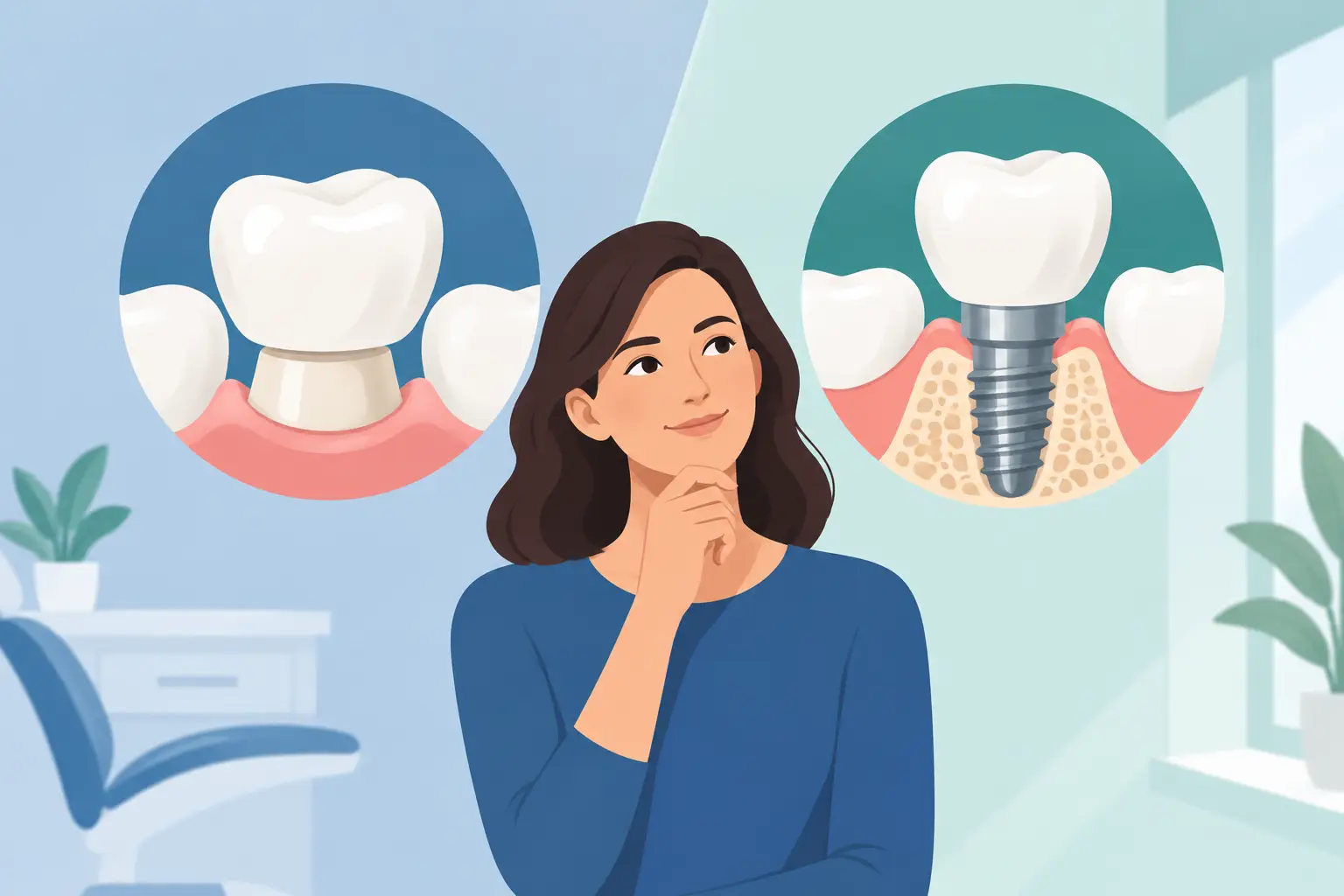
Crowns Versus Implants: Which One Fits You?
A cracked molar that hurts when you chew and a tooth that is already missing may both affect your confidence, but they do not call for the same solution. When comparing crowns versus implants, the first question is not which treatment is better. It is whether the natural tooth can be predictably saved.
A dental crown protects and restores a damaged tooth that still has a healthy, usable root. A dental implant replaces a missing tooth from the root up. Both can look natural, restore chewing function, and support a healthier smile. The right choice depends on your tooth, gum and bone health, timeline, budget, and long-term goals.
Crowns Versus Implants: The Core Difference
A crown is a custom-made cover that fits over an existing tooth. It is often recommended after a large cavity, fracture, root canal treatment, or replacement of an old, failing restoration. The crown strengthens the remaining tooth structure while restoring its shape, color, and bite.
An implant is a small titanium post placed in the jawbone to replace a tooth root that is missing or needs to be removed. After the implant heals and bonds with the bone, it supports an abutment and a custom crown. Although people sometimes say they are choosing between a crown and an implant, an implant-supported tooth usually includes a crown too. The distinction is what supports that crown: your natural tooth or an implant post.
Whenever a tooth has a strong enough foundation, preserving it is usually the more conservative approach. Removing a tooth that could be restored is rarely the first choice. But a tooth with a deep fracture, severe decay below the gumline, advanced bone loss, or repeated infection may not have a dependable future. In that situation, replacing it with an implant can be the more predictable investment.
When a Dental Crown Is the Better Choice
A crown may be the right fit when enough healthy tooth and root structure remain to support it. Your dentist will evaluate the tooth with an exam and digital X-rays, looking at the condition of the roots, surrounding bone, gumline, bite, and any existing fillings or cracks.
Crowns are commonly used to restore a tooth after root canal therapy. Removing infected tissue can leave a tooth more brittle, and a crown helps protect it from splitting under everyday chewing forces. A crown can also restore a tooth with a large filling when there is not enough natural structure left for another filling to last.
The timeline is often shorter than implant treatment. Depending on your needs and the type of crown selected, restoration may be completed in a small number of visits. This can matter when you need to get back to comfortable eating, speaking, and smiling without a lengthy treatment process.
A crown does require ongoing care. It cannot decay, but the natural tooth underneath can develop decay at the crown edge if plaque accumulates. Daily brushing, flossing around the gumline, regular cleanings, and a nightguard if you grind your teeth all help protect the investment.
When an Implant May Be the Better Choice
An implant is designed for a tooth that is already missing or cannot be saved. Because it replaces the root, it functions independently from neighboring teeth. That is a major advantage over a traditional bridge, which generally requires reshaping the teeth on either side of the gap to support the restoration.
Implants may also help preserve jawbone in the area of a missing tooth. After a tooth is lost, the bone that once supported its root can gradually shrink. Implant placement stimulates the bone much like a natural root does, although the outcome depends on your individual health and treatment timing.
Implants are especially appealing for patients who want a fixed replacement that does not come out at night. With a well-designed implant crown, many people can eat a wide range of foods and smile without worrying about a removable appliance shifting.
The trade-off is that implant treatment takes more planning and more time. After placement, the implant needs a healing period before it can carry its final crown. Some patients also need bone grafting, gum treatment, or tooth extraction before placement. Smoking, uncontrolled diabetes, active gum disease, certain medications, and heavy grinding can affect candidacy or require additional planning.
Cost, Time, and Long-Term Value
Cost is a real part of the decision, and the lowest immediate price is not always the lowest cost over time. A crown is generally less expensive upfront than an implant because it does not involve surgery or a replacement root. However, if a heavily damaged tooth has a poor prognosis and fails soon after it is crowned, you may ultimately need extraction and an implant anyway.
Implants usually involve a larger initial investment. The complete cost can include imaging, extraction when needed, bone grafting, surgical placement, the abutment, and the final crown. Treatment plans vary, so a personalized consultation is the best way to understand what is included and whether phased care is possible.
Insurance coverage can vary significantly. Some plans may contribute toward a crown but provide limited benefits for implants or related procedures. Patients without insurance should also ask about available discounts, financing options, and ways to prioritize urgent treatment first. Clear financial information helps you make a decision based on health and value, not pressure.
How Your Dentist Decides What Is Predictable
A good recommendation should be based on more than what looks best on an X-ray. Your dentist will consider whether the tooth can be restored with enough strength to handle your bite, whether the gums and bone are healthy, and whether decay or fracture extends too far below the gumline.
Your chewing pattern matters as well. Someone who clenches or grinds may need bite protection whether they choose a crown or an implant. A front tooth has different cosmetic demands than a back molar, while a missing tooth in a visible area may require careful planning to achieve natural gum contours and color match.
The rest of your mouth matters, too. If several teeth are worn, missing, or failing, treating one tooth without considering the overall bite can lead to repeated problems. Comprehensive treatment planning looks at your full smile and function, helping determine whether a crown, implant, bridge, orthodontic adjustment, gum treatment, or a combination of services makes the most sense.
Questions Worth Asking at Your Consultation
You deserve a straightforward explanation of your choices. Ask whether your tooth can be saved predictably, not simply whether it can be crowned today. Ask what the expected lifespan of each option may be in your case, what could cause it to fail, and what follow-up care will be needed.
It is also reasonable to ask about timing. If extraction is necessary, can an implant be placed at the same visit, or does the site need time to heal? Will a temporary tooth be available while the final restoration is being made? Understanding each stage makes the process less stressful, especially for patients who have delayed care because of anxiety.
For Rancho Cucamonga patients, a multi-specialty office such as Star Dental Group can coordinate restorative, implant, cosmetic, and general dental care in one place. That can make the process more convenient when your treatment requires more than one type of expertise.
A damaged or missing tooth does not have to dictate what you eat, how you speak, or how freely you smile. Schedule a consultation while the options are still open, and choose the treatment that gives your mouth the strongest, healthiest path forward.

