


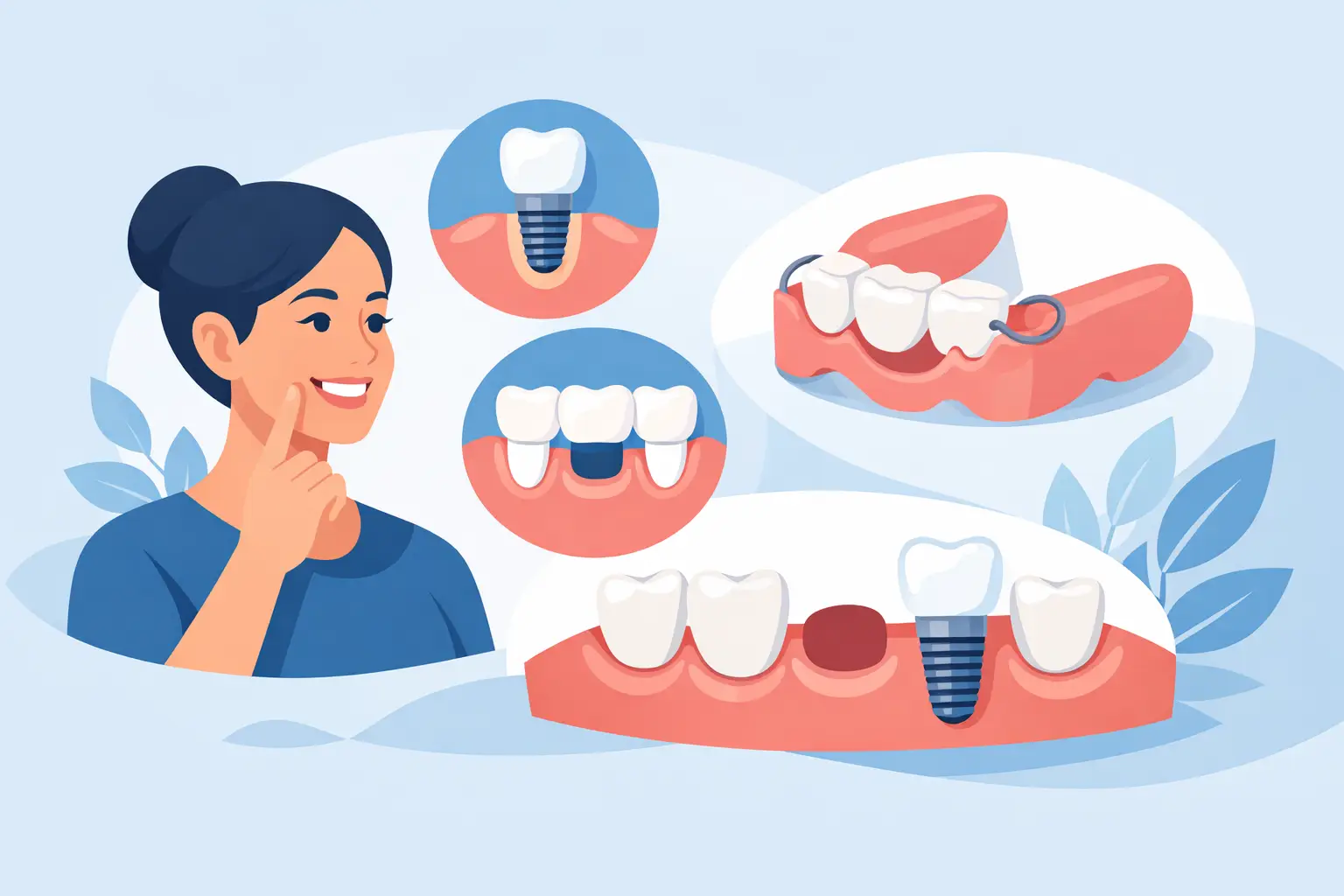
Missing Teeth Treatment Options That Fit Your Smile
A missing tooth can change more than a photograph. It can make chewing feel uneven, affect clear speech, and leave nearby teeth without the support they need. The right missing teeth treatment options can restore function and confidence while helping protect your long-term oral health.
There is no single best answer for every patient. The number and location of missing teeth, the health of your gums and jawbone, your budget, and your goals for your smile all matter. A comprehensive dental exam gives you the clarity to choose a solution that feels right for your life, not just right on paper.
Why replacing missing teeth matters
When a tooth is lost, the surrounding teeth may gradually shift toward the empty space. That movement can change your bite, create areas that are harder to clean, and place extra stress on certain teeth. If a tooth has been missing for a while, the jawbone beneath it can also lose density because it is no longer receiving the stimulation of a natural tooth root.
For some people, a missing tooth is most noticeable while smiling. For others, the bigger concern is eating comfortably or avoiding strain on the remaining teeth. Replacing the tooth can address both the functional and cosmetic sides of the issue.
Timing can make a difference. Prompt treatment may help preserve the space and simplify your options, but it is never too late to ask what can be done. Even when bone loss or shifting has occurred, modern dentistry offers ways to rebuild a healthy, stable smile.
Missing teeth treatment options to consider
A dentist will typically recommend one of several approaches: dental implants, a dental bridge, removable dentures, or, in some cases, no replacement. Each choice comes with advantages and trade-offs.
Dental implants
A dental implant replaces the root of a missing tooth with a small post placed in the jawbone. Once it integrates with the bone, a custom crown, bridge, or full-arch restoration can be attached. The visible restoration is designed to match the shape and color of your surrounding teeth.
Implants are often a strong choice for patients who want a fixed, natural-looking solution. Because an implant stimulates the jawbone, it can help limit bone loss in the area of the missing tooth. It also stands independently, so adjacent healthy teeth generally do not need to be reshaped to support it.
The main consideration is that implant treatment takes planning and healing time. Some patients need a bone graft before placement if the jawbone needs additional support. Cost can also be higher upfront than a bridge or removable appliance, although many patients value the durability and long-term benefits. For a single tooth, several teeth, or an entire arch, implants can be adapted to meet different restoration needs.
Dental bridges
A dental bridge fills a gap by attaching a replacement tooth, called a pontic, to crowns on the teeth beside it. Bridges can also be supported by implants rather than natural teeth in certain cases. They are custom-made to blend into your smile and remain fixed in place.
A traditional bridge can be a practical option when the teeth next to the missing space already need crowns due to large fillings, wear, or damage. It usually requires less treatment time than an implant and can restore chewing ability quickly.
The trade-off is that a traditional bridge requires preparation of the neighboring teeth, even if those teeth are otherwise healthy. Bridges do not replace the missing root below the gumline, so they do not provide the same bone stimulation as an implant. Care is also important: cleaning beneath the replacement tooth requires a floss threader, interdental brush, or another recommended tool.
Partial dentures
A removable partial denture replaces one or more missing teeth. It is made to fit around your remaining teeth and may use discreet clasps or other attachments for stability. Modern partial dentures can be more natural-looking and comfortable than many people expect.
This option can work well when multiple teeth are missing in different areas of the mouth or when a patient needs a more budget-conscious solution. A partial denture is also non-surgical, which may be appealing for patients who are not candidates for implant placement or who prefer to avoid surgery.
Because it is removable, it requires daily cleaning and should be taken out at night unless your dentist advises otherwise. Some patients need time to adjust to speaking and chewing with a partial. Fit can also change over time as the gums and jawbone change, making periodic adjustments necessary.
Full dentures and implant-supported dentures
When all teeth in the upper or lower arch are missing, a full denture can restore the appearance of a complete smile and make eating and speaking easier. Conventional dentures rest on the gums and are removable. They can be an affordable way to replace a full arch of teeth, especially when treatment needs to move forward without surgery.
However, conventional dentures may shift during eating or speaking, particularly in the lower jaw. Adhesives can help some patients, but they do not solve every fit concern. The jawbone may continue to change over time, so relines or replacement dentures may eventually be needed.
Implant-supported dentures offer added stability. A removable denture can snap onto implants, or a full-arch fixed restoration may be secured in place by implants. These options can provide a firmer bite and reduce the movement that frustrates many denture wearers. They require sufficient bone or appropriate preparation, but they can be life-changing for patients who want more security than a traditional denture offers.
Leaving the space untreated
In limited situations, a dentist may recommend monitoring a missing tooth rather than replacing it immediately. For example, the space may not affect function, the surrounding teeth may be stable, or medical and financial priorities may need attention first.
Still, choosing not to replace a tooth should be a deliberate clinical decision, not simply something that gets put off indefinitely. A dentist can monitor bite changes, tooth movement, gum health, and bone levels so you understand whether waiting creates additional treatment needs later.
How dentists decide which treatment fits
The best treatment starts with a full-mouth view, not just a look at the empty space. Your dentist will evaluate the condition of the teeth next to the gap, your bite, gum health, bone level, and overall medical history. Digital imaging may be used to determine whether an implant can be placed safely and predictably.
Your everyday priorities matter, too. Someone who wants a non-removable solution and values long-term bone support may lean toward implants. Someone replacing several teeth with a limited budget may prefer a partial denture. A bridge may make excellent sense when adjacent teeth already require crowns. Good dentistry is not about pushing one treatment. It is about matching the treatment to the patient.
If anxiety has delayed care, tell your dental team. A supportive office can explain each step clearly, discuss comfort options, and break a larger treatment plan into manageable phases. Cost should also be part of an open conversation. Ask about the total treatment plan, expected maintenance, insurance considerations, and available payment or discount options before you decide.
Caring for your replacement teeth
Replacement teeth still need regular professional care. Implants, bridges, and dentures are not immune to plaque, gum inflammation, or wear. Brushing twice daily, cleaning between teeth or around restorations, and keeping routine dental visits can help protect your investment.
For implants, healthy gums and consistent hygiene are especially important. For bridges, cleaning under the pontic helps prevent decay and gum problems around the supporting teeth. Dentures should be cleaned daily and handled carefully to avoid warping or damage. Your dentist can show you the tools and techniques that fit your specific restoration.
At Star Dental Group, a comprehensive consultation can help you compare solutions in a comfortable, judgment-free setting. Whether you are missing one tooth or many, the goal is the same: a healthy smile that feels natural, functions well, and fits your needs. Taking the first step now can make meals, conversations, and smiles feel like your own again.

